Choosing the 2026 Best Ventilation System for Global Buyers requires more than comparing airflow numbers. A reliable Ventilation System must match building use, climate, occupancy, energy prices, maintenance skills, and local standards. A quiet apartment in Stockholm needs different controls from a humid coastal warehouse in Singapore. Dust, smoke, pollen, and heat also change the decision.
Dr. Joseph G. Allen, director of the Healthy Buildings program at Harvard T.H. Chan School of Public Health, has stated, “Ventilation is not a silver bullet, but it is an important layer of protection.” That practical view guides this introduction. Good ventilation supports cleaner indoor air, but filtration, humidity control, commissioning, and regular servicing matter too. Buyers should examine verified air-change performance, filter efficiency, sound levels, heat recovery, controls, and spare-parts access. Look beyond the brochure.
Real projects often reveal uncomfortable details. A powerful fan may waste energy. A high-efficiency filter may increase pressure and maintenance costs. Smart sensors can drift. Installation quality can quietly reduce performance. These weaknesses deserve attention, not polished promises.
This guide compares leading system types for homes, offices, schools, healthcare spaces, and industrial buildings. It considers regional conditions and practical ownership costs. Some rankings may remain debatable because no single system fits every market. That is the honest limitation. Buyers should confirm safety requirements, product certifications, warranty terms, and local professional advice before purchasing. Fresh air is valuable. Reliable delivery is harder.
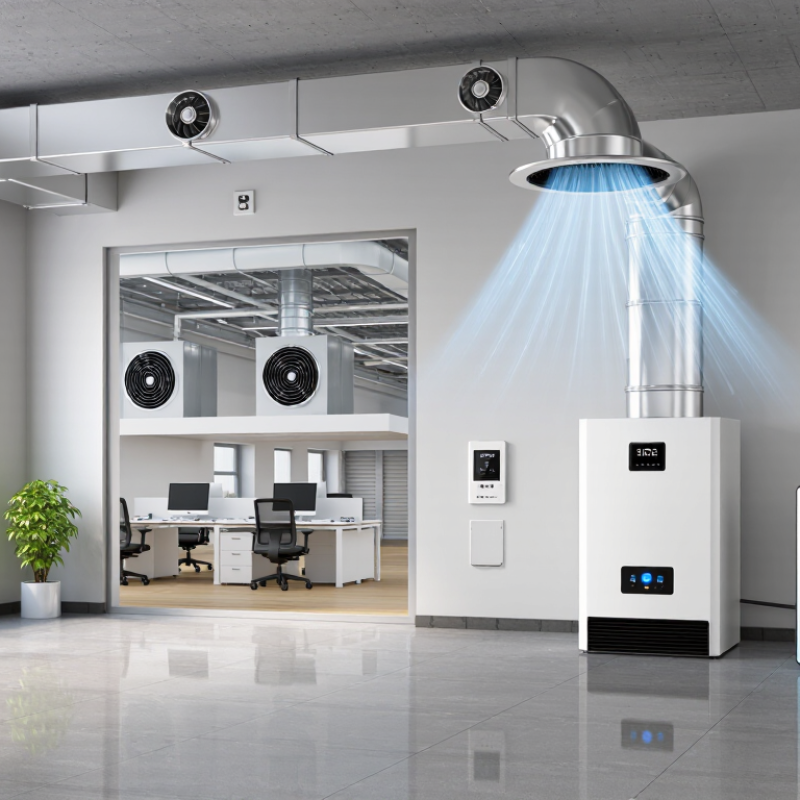
2026 Ventilation System Types: ASHRAE 62.1 Outdoor-Air Requirements
For global buyers, ventilation design should begin with ASHRAE 62.1 outdoor-air requirements, not with equipment selection. The applicable edition and local building code must be checked first. ASHRAE 62.1 is widely used, but it may not be legally adopted everywhere.
The required outdoor airflow depends on occupancy, floor area, space usage, and air distribution effectiveness. A classroom, restaurant, and warehouse need different ventilation rates. The Ventilation Rate Procedure combines people-based airflow with area-based airflow. Supply air must also reach the breathing zone effectively. Poor diffuser placement can reduce real performance, even when the fan meets its rated airflow.
Details matter. A crowded meeting room may need stronger control than its design average suggests. Carbon dioxide sensors can support demand-controlled ventilation, but they should not replace proper design or maintenance. Filters remove particles; they do not replace outdoor air. Exhaust systems also need balanced makeup air, especially near kitchens, laboratories, and washrooms.
Commissioning is often overlooked. Measure airflow at grilles, inspect dampers, and confirm sensor calibration after installation. A quiet fan is not automatically a healthy system. In practice, occupancy changes are difficult to predict, and design assumptions can become outdated. Buyers should request calculation sheets, testing records, control sequences, and local compliance evidence. These documents expose gaps before the first occupied day.
Global Standards: EN 16798-1 Categories from 4 to 15 L/s per Person
2026 Best Ventilation System for Global Buyers
EN 16798-1 links indoor air quality with outdoor airflow per person. Its typical categories range from 4 to 15 L/s per person. Category I uses about 15 L/s per person for sensitive occupants. Category II uses 10 L/s, while Category III uses 7 L/s. Category IV allows about 4 L/s per person.
These figures are design targets, not universal guarantees. CEN EN 16798-1:2019 also considers building emissions, occupancy, and pollution sources. A crowded meeting room needs more attention than a lightly used storage area. In practice, a 30-person room designed for Category II requires approximately 300 L/s of outdoor air. That is a substantial airflow rate.
Small details matter. A commissioning team should measure supply volume, room pressure, filter resistance, and carbon dioxide trends. REHVA guidance supports demand-controlled ventilation when occupancy changes quickly, but sensors need correct placement and calibration. A sensor near a supply diffuser may produce misleading comfort data.
Energy remains a difficult balance. The IEA Buildings 2023 report identifies buildings as responsible for roughly 30% of global final energy use. Higher ventilation rates can improve health conditions, yet they also increase heating and cooling loads. Category IV may look efficient, but it can be unsuitable for schools or healthcare spaces. My practical concern is simple: buyers often compare airflow numbers without checking maintenance access, climate, or commissioning evidence. The cheapest specification is not always the safest one.
2026 Best Ventilation System for Global Buyers - Global Standards: EN 16798-1 Categories from 4 to 15 L/s per Person
| EN 16798-1 Category |
Outdoor Air Rate
per Person |
Approx. Airflow
per Person |
Indicative Indoor Air Quality |
Typical Building Applications |
Recommended Ventilation Approach |
Key Buyer Considerations |
| Category I |
15 L/s per person |
≈31.8 cfm per person |
High level of expectation for indoor air quality; suitable where occupants are especially sensitive. |
Healthcare areas, high-quality residential spaces, premium offices, and sensitive-use rooms. |
Balanced mechanical ventilation with heat or energy recovery, demand control, and effective outdoor-air distribution. |
Check fan capacity, heat-recovery performance, acoustic limits, filtration, commissioning, and winter or summer peak loads. |
| Category II |
10 L/s per person |
≈21.2 cfm per person |
Normal expectation for a new or renovated building with good indoor environmental quality. |
General offices, schools, hotels, apartments, retail areas, and public buildings. |
Central or decentralized balanced systems; use CO₂-based demand control where occupancy varies. |
Compare total cost of ownership, specific fan power, sound levels, maintenance access, controls compatibility, and local electrical requirements. |
| Category III |
7 L/s per person |
≈14.8 cfm per person |
Acceptable indoor air quality for existing buildings or applications with less demanding comfort expectations. |
Standard commercial buildings, storage areas with regular occupancy, workshops, and budget-sensitive projects. |
Mechanical supply and exhaust or balanced ventilation sized for the actual occupancy and room use. |
Confirm that reduced airflow does not conflict with local health, workplace, fire, moisture, or pollutant-control requirements. |
| Category IV |
4 L/s per person |
≈8.5 cfm per person |
Lower level of expectation; generally considered acceptable only for limited-use or existing-building situations. |
Occasionally occupied spaces, utility areas, temporary facilities, and selected existing-building applications. |
Simple mechanical exhaust, supply ventilation, or basic balanced ventilation, subject to local code approval. |
Do not select this level solely to reduce equipment size; assess contaminant sources, occupancy duration, humidity, and applicable national regulations. |
Technical note: The airflow figures above are commonly used outdoor-air rates per person associated with the four indoor environmental quality categories in EN 16798-1. Final ventilation design must also consider floor area, occupancy density, building materials, pollutant sources, room type, exhaust requirements, climate, and the regulations applicable in the project location. The conversion used is 1 L/s ≈ 2.12 cfm.
Filtration Performance: ISO 16890 ePM1, ePM2.5, and ePM10 Ratings
2026 Best Ventilation System for Global Buyers
Filtration Performance: ISO 16890 ePM1, ePM2.5, and ePM10 Ratings
For global buyers, ventilation performance should begin with tested filter efficiency. ISO 16890 classifies air filters by removal performance across different particle size ranges. The key categories are ePM1, ePM2.5, and ePM10. ePM1 addresses the smallest tested fraction, including particles linked to combustion and urban pollution. ePM2.5 covers a broader fine-particle range. ePM10 reflects larger inhalable particles, including dust and some pollen. These ratings describe tested efficiency, not identical indoor air quality everywhere.
In practice, an ePM1-rated filter may suit offices near busy roads, clinics, or homes affected by wildfire smoke. A dusty workshop may require stronger ePM10 performance and prefiltration. Real selection is less tidy. Higher efficiency can increase pressure drop, especially as the filter loads with dust. Fans may then work harder, while airflow falls and electricity use rises. Check the pressure-drop curve, airflow requirement, filter dimensions, and replacement schedule. A rating alone is not enough.
During commissioning, measure airflow at supply grilles, not only at the fan. Inspect seals, because bypass air can defeat a well-tested filter. I have seen clean filters underperform when frames were poorly fitted. That detail is easy to miss. ISO 16890 results also depend on laboratory methods and conditioning. Local humidity, maintenance habits, and outdoor pollution can change field results. Buyers should request traceable test documentation and compare performance at the actual design airflow. Sometimes the cheaper choice costs more later.
Energy Efficiency: Heat-Recovery Ventilators with Up to 80% Recovery
2026 Best Ventilation System for Global Buyers
Heat-recovery ventilators can recover up to 80% of heat from outgoing air. This figure usually refers to laboratory-tested sensible heat recovery, not total energy savings. Real performance depends on airflow, climate, filter condition, and installation quality. A well-sized unit can bring fresh air into a bedroom while keeping winter warmth indoors. In summer, it can reduce the load on cooling equipment.
Field experience shows that commissioning matters as much as the equipment itself. Technicians should measure supply and exhaust airflow at each room, then balance the system carefully. Poor balancing may create drafts, odors, or pressure problems. Frost protection also deserves attention in cold regions. Defrost cycles can reduce recovery for short periods. That is normal, but buyers should check the control strategy before purchase.
Maintenance is simple, but often neglected. Replace or clean filters according to local dust levels, not only the calendar. A blocked filter increases fan energy and weakens ventilation. I have seen attractive recovery figures perform poorly after months of dust buildup. The 80% figure is useful, but it should not be treated as a guarantee. Buyers should request certified test data, operating noise levels, winter performance information, and clear service instructions. Regional voltage, duct design, humidity, and available spare parts also affect long-term reliability.
2026 Best Ventilation System for Global Buyers
Typical heat-recovery efficiency by ventilation technology
Counterflow heat-recovery ventilators can achieve around 80% sensible heat recovery in suitable operating conditions. Actual performance depends on airflow balance, temperature difference, frost protection, filter condition, installation quality, and local climate.
System Sizing: Air Changes, CO₂ Control, Noise, and Fan Power Limits
The best ventilation system in 2026 is not the largest one.
It is the system sized for real occupancy, climate, and building use. Air changes per hour provide a useful starting point, but they cannot replace room-by-room calculations. A bedroom, classroom, kitchen, and workshop require different airflow strategies.
Measure twice. Then check the assumptions.
CO₂ control adds a practical feedback signal. In occupied rooms, sensors can increase outdoor air when levels rise, while reducing airflow during empty periods. Many projects target approximately 800–1,000 ppm, but local standards and outdoor conditions still matter.
Sensor placement is critical; a unit near a supply grille may report misleadingly clean air. This detail is easy to miss.
Noise should be assessed at occupied positions, not beside the fan. Comfortable spaces often need careful duct design, lower air velocity, and vibration isolation.
Fan power also deserves a hard limit, because excessive static pressure quietly increases operating costs. Select the fan from its actual duty point, including filters, dampers, coils, and duct losses.
A neat spreadsheet can still be wrong. Commissioning should include airflow readings, CO₂ trends, sound checks, and filter inspection.
I would not trust design figures without field verification, especially after late construction changes.
Conclusion
Choosing the right Ventilation System in 2026 requires balancing indoor air quality, energy use, comfort, and regulatory compliance. Global buyers should compare system types according to outdoor-air requirements, including the principles of ASHRAE 62.1, while also considering EN 16798-1 categories that typically range from approximately 4 to 15 L/s per person. Proper filtration is equally important, with ISO 16890 classifications such as ePM1, ePM2.5, and ePM10 helping users match filter performance to local air-quality needs.
Effective system selection also depends on heat-recovery capability, with modern heat-recovery ventilators potentially recovering up to 80% of exhausted energy under suitable conditions. Correct sizing should account for air changes, occupancy, CO₂ levels, room function, noise limits, and fan power consumption. By evaluating these factors together, buyers can select a reliable, efficient, and adaptable solution for residential, commercial, and industrial applications.
 Chiye Fan
