 Chiye Fan
2026 Top Industrial Fan Types for Global Buyers
Choosing the right Industrial Fans has become a practical challenge for global buyers in 2026. Factories now manage higher heat loads, stricter energy targets, limited floor space, and changing production schedules. A fan that performs well in a clean warehouse may struggle beside a dusty kiln or chemical process line.
Dr. Roger Legg, an industrial ventilation specialist and author, states, “Fan selection begins with the duty point, not the catalogue headline.” That principle remains essential. Buyers should compare airflow, static pressure, temperature, noise, efficiency, materials, maintenance access, and control compatibility. Axial fans may suit large-volume air movement, while centrifugal fans often handle higher pressure and demanding duct systems. Mixed-flow, plug, roof exhaust, and explosion-protected designs may solve more specific operating problems.
The details matter.
A 1,200-millimeter axial fan can move substantial air, yet poor duct alignment may waste much of its output. A compact centrifugal unit may consume less space but require careful filter and bearing maintenance. Global purchasing teams must also verify voltage, frequency, environmental ratings, documentation, spare-parts support, and local certification needs.
No single ranking fits every plant. Even this guide has limits. Product data can look impressive until real dust, heat, corrosion, or restricted airflow enters the picture. For that reason, the 2026 comparison focuses on application evidence rather than marketing claims. It considers where each Industrial Fans type works best, where it may fail, and which questions buyers should ask before approving a purchase.
Industrial Fan Basics and the Role of Each Fan Type
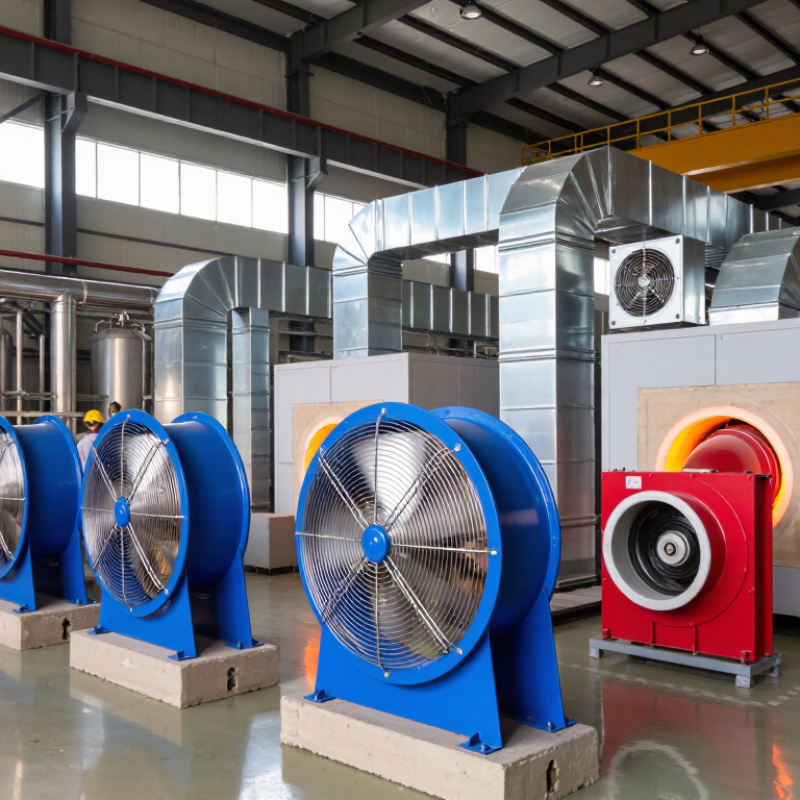
Industrial fans move air for cooling, ventilation, drying, combustion support, and contaminant control. Their basic job sounds simple: deliver the required airflow against system resistance. That resistance comes from ducts, filters, dampers, grilles, and process equipment. Axial fans push air parallel to the shaft and suit high-volume, low-to-medium-pressure movement. They often serve warehouses, cooling towers, and large exhaust openings. Centrifugal fans turn airflow outward through an impeller. They handle higher static pressure and work well with long ducts, filters, and dust-collection systems. Radial-blade designs tolerate heavier particles, while backward-curved wheels usually improve efficiency. Mixed-flow fans sit between axial and centrifugal designs, offering compact installation with moderate pressure capability.
Industrial roof exhaust fans remove hot, humid air from production buildings. Tube axial fans support direct, straight-through airflow in ventilation systems. The right choice depends on air volume, pressure, temperature, moisture, corrosion, noise, and available space. It is tempting to choose by airflow alone. That shortcut often fails. An oversized fan may waste energy and create unnecessary noise. An undersized fan may leave workers near hot equipment uncomfortable. Small details matter. Field measurements should verify pressure losses, duct dimensions, and operating temperatures. Catalog data is useful, but actual site conditions can differ. That gap deserves attention. Fan access also affects cleaning, bearing checks, belt replacement, and safe long-term operation. A practical review should question every assumption, especially when dust buildup or seasonal airflow changes are expected.
| Industrial Fan Type | Basic Operating Principle | Typical Airflow Capability | Typical Pressure Capability | Primary Industrial Role | Common Applications | Main Advantages | Key Selection Considerations |
|---|---|---|---|---|---|---|---|
| Axial Fan | Air moves parallel to the rotating shaft through propeller-style blades. | Approximately 1,000–500,000 m³/h | Low to medium; commonly up to about 1,000 Pa | Moving large air volumes where system resistance is relatively low. | General factory ventilation, cooling halls, warehouses, agricultural buildings, and condenser airflow. | High air volume, compact construction, simple installation, and comparatively low initial cost. | Check system resistance, noise level, weather protection, blade material, and required airflow uniformity. |
| Tube Axial Fan | An axial impeller operates inside a cylindrical casing to guide and stabilize the airflow. | Approximately 2,000–300,000 m³/h | Medium; commonly about 300–1,500 Pa | Providing higher-pressure axial ventilation through ducted systems. | Tunnels, underground facilities, process ventilation, spray booths, and long duct runs. | Good space efficiency, direct airflow path, and suitability for ducted installation. | Evaluate duct losses, fan-system operating point, vibration control, and motor cooling. |
| Centrifugal Fan with Backward-Curved Blades | Air enters along the shaft and is discharged radially after gaining velocity from the impeller. | Approximately 1,000–250,000 m³/h | Medium to high; commonly about 500–5,000 Pa | Delivering efficient airflow against moderate or high system resistance. | Dust collection, air-handling units, combustion air, industrial exhaust, and process drying. | High efficiency, stable performance, and generally non-overloading power characteristics. | Confirm dust loading, gas temperature, corrosion exposure, impeller balance, and required efficiency class. |
| Centrifugal Fan with Forward-Curved Blades | A compact impeller with forward-curved blades produces high airflow at relatively low to medium pressure. | Approximately 500–100,000 m³/h | Low to medium; commonly about 200–1,500 Pa | Supplying substantial airflow in compact air-moving equipment. | Air-handling units, heating and ventilation equipment, clean-air circulation, and compact process systems. | Compact size, high airflow at low pressure, and relatively low rotational speed. | Use only where system resistance is suitable; check motor overload risk, cleanliness of air, and noise. |
| Radial-Blade Centrifugal Fan | Straight radial blades accelerate air outward and are designed for demanding or contaminated airstreams. | Approximately 500–150,000 m³/h | Medium to high; commonly about 1,000–7,500 Pa | Handling particulate-laden, abrasive, or process exhaust air. | Dust extraction, foundries, woodworking, cement handling, chemical processing, and material conveying. | Robust construction, good resistance to fouling, and suitability for heavier dust loads. | Specify particle size, concentration, abrasion rate, temperature, explosion risk, and wear protection. |
| Mixed-Flow Fan | The impeller combines axial and centrifugal airflow characteristics to produce both high volume and useful pressure. | Approximately 1,000–200,000 m³/h | Medium; commonly about 500–2,500 Pa | Balancing high airflow with moderate duct-system resistance. | Industrial ventilation, smoke control, tunnel systems, cooling applications, and compact duct networks. | Good pressure-to-size ratio, relatively compact design, and flexible installation options. | Compare the fan curve with the complete system curve and verify control range and sound performance. |
| Roof Exhaust Fan | A roof-mounted fan extracts indoor air directly through the roof or a short discharge connection. | Approximately 2,000–100,000 m³/h | Low; commonly about 100–800 Pa | Removing hot, stale, humid, or contaminated air from large buildings. | Factories, warehouses, workshops, livestock buildings, commercial kitchens, and process areas. | Efficient use of roof space, simple exhaust layout, and effective heat removal. | Consider roof structure, weatherproofing, backdraft prevention, maintenance access, and discharge location. |
| Plug Fan | A motor-impeller assembly operates without a conventional scroll casing and is commonly installed inside an air-handling unit. | Approximately 1,000–250,000 m³/h | Medium to high; commonly about 500–3,000 Pa | Providing efficient, modular airflow within air-handling and process equipment. | Air-handling units, cleanrooms, data centers, industrial HVAC, and heat-recovery systems. | Space-efficient layout, flexible discharge direction, easy integration, and compatibility with variable-speed drives. | Check inlet and outlet clearances, system integration, control method, motor protection, and service access. |
| High-Volume, Low-Speed (HVLS) Fan | A large-diameter fan rotates slowly to circulate air across a broad floor area rather than create high static pressure. | Approximately 50,000–1,000,000 m³/h of air movement | Very low; generally below about 100 Pa | Improving air mixing, occupant comfort, and destratification in large open spaces. | Distribution centers, manufacturing plants, aircraft hangars, sports facilities, and agricultural buildings. | Wide coverage, low operating speed, reduced temperature stratification, and efficient air circulation. | Assess ceiling height, structural loading, sprinkler clearance, pedestrian safety, controls, and local codes. |
| Smoke Extract and Fire-Rated Fan | A specially rated axial or centrifugal fan removes smoke and hot gases during emergency conditions. | Approximately 5,000–250,000 m³/h | Medium to high; commonly about 500–3,000 Pa | Maintaining tenable evacuation routes and supporting smoke-control strategies. | Car parks, tunnels, high-rise buildings, industrial facilities, and enclosed public spaces. | Designed for elevated-temperature operation and integration with emergency-control systems. | Verify the required fire-temperature rating, test certification, redundancy, emergency power, and local regulations. |
| Explosion-Protected Industrial Fan | A fan system is configured to reduce ignition risks when operating in potentially explosive atmospheres. | Approximately 500–150,000 m³/h | Low to high, depending on impeller and system design | Ventilating areas where flammable gases, vapors, mists, or combustible dust may be present. | Paint facilities, chemical plants, solvent handling, grain processing, battery manufacturing, and fuel storage areas. | Supports hazardous-area ventilation when correctly specified and installed. | Match the complete assembly to the applicable hazardous-area classification, gas or dust group, temperature class, and certification requirements. |
| High-Temperature Process Fan | A reinforced fan system uses heat-resistant materials, cooling arrangements, and suitable bearings for hot gases. | Approximately 1,000–200,000 m³/h | Medium to high; commonly about 500–5,000 Pa | Moving hot process gases while maintaining mechanical and material reliability. | Furnaces, kilns, incinerators, heat-treatment lines, dryers, and thermal processing equipment. | Suitable for continuous or intermittent high-temperature service when properly engineered. | Specify operating and peak temperature, gas composition, corrosion, thermal expansion, cooling, and bearing arrangement. |
Note: Airflow and pressure figures are indicative industry ranges rather than universal limits. Final fan selection should be based on the complete system curve, air density, temperature, gas composition, dust concentration, noise requirements, duty cycle, efficiency targets, applicable safety standards, and local electrical regulations.
FAQS
It moves a required volume of air against resistance from ducts, filters, dampers, and equipment. The task sounds simple. Actual conditions can differ.
Axial fans move air parallel to the shaft. They suit high-volume, low-to-medium-pressure applications. Common locations include warehouses, cooling towers, and large exhaust openings.
Centrifugal fans turn air outward through an impeller. They handle higher static pressure and longer ducts. They also suit filters and dust-collection systems. Radial blades tolerate heavier particles, while backward-curved wheels often improve efficiency.
Mixed-flow fans combine features of axial and centrifugal designs. They offer compact installation and moderate pressure capability. They may fit sites with limited space. The choice still needs pressure verification.
Airflow alone ignores pressure loss, temperature, moisture, corrosion, noise, and available space. An oversized fan can waste energy and increase noise. An undersized fan may leave workers uncomfortable near hot equipment. That shortcut often fails.
Check duct dimensions, pressure losses, operating temperatures, and expected airflow changes. Review filters, dampers, grilles, and process equipment. Catalog data helps, but field measurements are more realistic. Assumptions may need revision.
Hot areas may require high-temperature bearings, heat-resistant insulation, and motors away from radiant heat. Corrosive areas may need stainless steel, coated steel, or reinforced polymer parts. No material resists every chemical. Inspect blades, housings, fasteners, and drain points. Small rust marks matter.
Match the fan to the hazardous-area classification, gas or dust conditions, temperature limits, and electrical requirements. Spark-resistant construction can reduce ignition risk, but it is not a complete safety assessment. Grounding, bonding, vibration monitoring, and maintenance remain essential. Do not rely on airflow figures alone.
Conclusion
This guide explains the main Industrial Fans used in modern factories, warehouses, processing plants, and other large facilities. It begins with the basic principles of fan operation and shows how each type supports ventilation, cooling, material handling, or air cleaning. Axial fans are highlighted for moving large volumes of air across spacious areas, while centrifugal fans are presented as a strong choice when systems require higher pressure, duct resistance, or dust-handling capability.
The article also introduces specialized fan designs for demanding conditions, including high temperatures, corrosive environments, and areas requiring carefully controlled ignition risks. For global buyers in 2026, selecting the right fan involves comparing airflow, pressure, efficiency, materials, noise, maintenance needs, installation requirements, and compliance with local safety standards. By matching fan performance and construction to the operating environment, purchasers can improve reliability, energy management, worker comfort, and long-term operating value.
