 Chiye Fan
Why Choose a Low Noise Fan for Your Business?
In a busy workplace, fan noise can shape more than comfort. It affects conversations, concentration, and how customers experience a space. A Low Noise Fan can help reduce that distraction in offices, clinics, shops, studios, and production areas. But “quiet” should not be the only buying criterion. A fan that sounds gentle yet moves too little air may leave rooms warm, equipment strained, or staff dissatisfied. The right choice balances sound, airflow, energy use, durability, and the demands of each room. Small details matter.
Before choosing a model, compare its sound rating and airflow at the speed you expect to use—not only its best-case figures. Check the measurement units and testing conditions, since ratings from different manufacturers may not be directly comparable. Consider room size, ceiling height, operating hours, and whether the fan will sit near desks or customers. A soft hum can feel intrusive in a quiet consultation room, while the same sound may disappear beneath ordinary shop activity. Installation matters, too: loose fittings, vibration, and poor placement can make a quiet unit seem louder. There is no perfect fan for every business. A lower decibel number alone does not prove better performance. This guide explores how to weigh noise against airflow, efficiency, maintenance, and budget, helping buyers ask better questions and avoid choices that look good on a specification sheet but disappoint on site. A specification cannot fully predict every room.
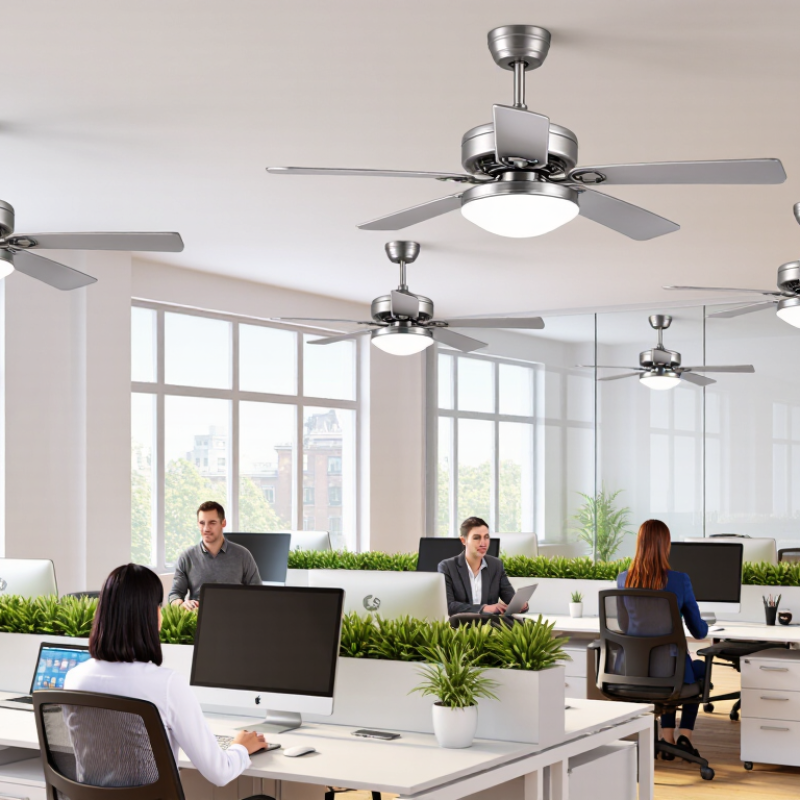
Define Fan Noise Using dB(A), Sound Pressure, and Sound Power
Why Choose a Low Noise Fan for Your Business?
Define Fan Noise Using dB(A), Sound Pressure, and Sound Power
Fan noise is not captured by one number. dB(A) describes a sound level adjusted to reflect how human hearing responds to different frequencies. Sound pressure is measured at a particular location, such as beside a workstation. It changes with distance, room surfaces, and background noise. Sound power describes the acoustic energy emitted by the fan itself, making it more useful for comparing equipment under defined test conditions. That distinction matters.
ISO 11201:2010 specifies methods for measuring emission sound pressure at workstations and other stated positions. ISO 3744:2010 describes determining sound power from sound pressure measurements in defined conditions. When reviewing specifications, check which value is reported, the measurement method, fan speed, and operating setup. A low dB(A) figure from one test may not predict the level beside a desk in a reflective room.
NIOSH’s 1998 Criteria for a Recommended Standard: Occupational Noise Exposure sets an 85 dBA recommended exposure limit for an eight-hour time-weighted average, using a 3 dB exchange rate. This is an occupational exposure reference, not a product pass-or-fail limit. Still, it shows why sustained noise deserves attention. A fan can meet a stated sound-power figure and remain intrusive nearby. Small details matter: installation distance, vibration, and room reflections can change what people actually hear.
Why Choose a Low Noise Fan for Your Business? - Define Fan Noise Using dB(A), Sound Pressure, and Sound Power
The figures below are illustrative planning ranges for business ventilation fans, not measurements of a specific product. Actual noise depends on fan design, speed, airflow, installation, room acoustics, and measurement conditions.
| Fan operating profile | Illustrative sound pressure at 1 m, LpA | Approximate sound power, LwA | Typical business consideration |
|---|---|---|---|
| Low-speed, quiet operation | 30–40 dB(A) | 38–48 dB(A) | Often suitable for offices, meeting rooms, and other noise-sensitive areas. |
| Standard ventilation operation | 40–50 dB(A) | 48–58 dB(A) | May work well in general commercial spaces when equipment is installed away from quiet work areas. |
| High-airflow or high-speed operation | 50–60 dB(A) | 58–68 dB(A) | Can be appropriate for service areas, but placement and noise control may matter near occupied spaces. |
dB(A): A-weighted decibels adjust measured sound to reflect how human hearing responds to different frequencies.
Sound pressure (LpA): The sound level at a particular location. It changes with distance, room reflections, and measurement conditions.
Sound power (LwA): A measure of the acoustic energy emitted by the fan. It is useful for comparing sources, but it is not the sound level a person will hear at a specific location. The approximate sound-power ranges above assume a free-field hemispherical setup, for which sound pressure at 1 m is roughly 8 dB lower than sound power; actual results can differ.
FAQS
NIOSH recommends an eight-hour average of 85 dBA. Every 3 dB increase halves the recommended exposure time. Noise adds up.
OSHA’s general-industry limit is 90 dBA over eight hours, using a 5 dB exchange rate. Its 85 dBA action level triggers hearing-conservation requirements.
It can reduce one steady noise source and make alarms or instructions easier to hear. It cannot replace exposure measurements or other needed controls.
Measure where employees actually work, such as beside a counter or production station. Check exposure across a representative shift, not only beside the fan.
Compressors, traffic, nearby equipment, and room reflections all matter. Several machines can make a quiet corner noisy. Easy to miss.
Compare required airflow with the fan’s performance curve. Consider duct length, tight bends, grilles, and dirty filters, which increase resistance.
It is the resistance the fan must overcome. Check where required airflow and pressure meet on the performance curve. That operating point matters.
No. They are different measurements and should not be compared as if they were interchangeable. Room shape and mounting also affect what workers hear.
Check airflow and noise under real operating conditions. Keep measurement records and repeat checks after equipment or layouts change. My first estimate may be wrong.
Conclusion
Choosing a Low Noise Fan can improve workplace comfort while supporting reliable ventilation. Fan noise is commonly measured in dB(A), a scale adjusted to reflect how people perceive sound. Sound pressure describes noise at a particular location, while sound power represents the total acoustic energy produced by the fan. Understanding both helps businesses compare ratings and estimate how noise may affect workers in their actual environment.
Noise exposure also depends on how long people are near the equipment. NIOSH recommends limiting exposure to 85 dBA over an eight-hour workday, while OSHA’s limit is 90 dBA over eight hours, with exposure time reduced for each 5 dB increase. Check that published sound ratings use ANSI/AMCA 300 test methods, then select a fan that meets the required airflow and static pressure. Matching performance needs accurately can help avoid unnecessary noise without compromising ventilation.
